Overview
The U.S. Army Engineer Research and Development Center (ERDC) invites solutions to support the engineering design of an emergency closure system for Winfield Locks and Dam in Winfield, West Virginia. This effort aims to develop a deployable closure system capable of halting uncontrolled flow during a primary roller gate failure while operating within existing site constraints and load handling capabilities.
Background
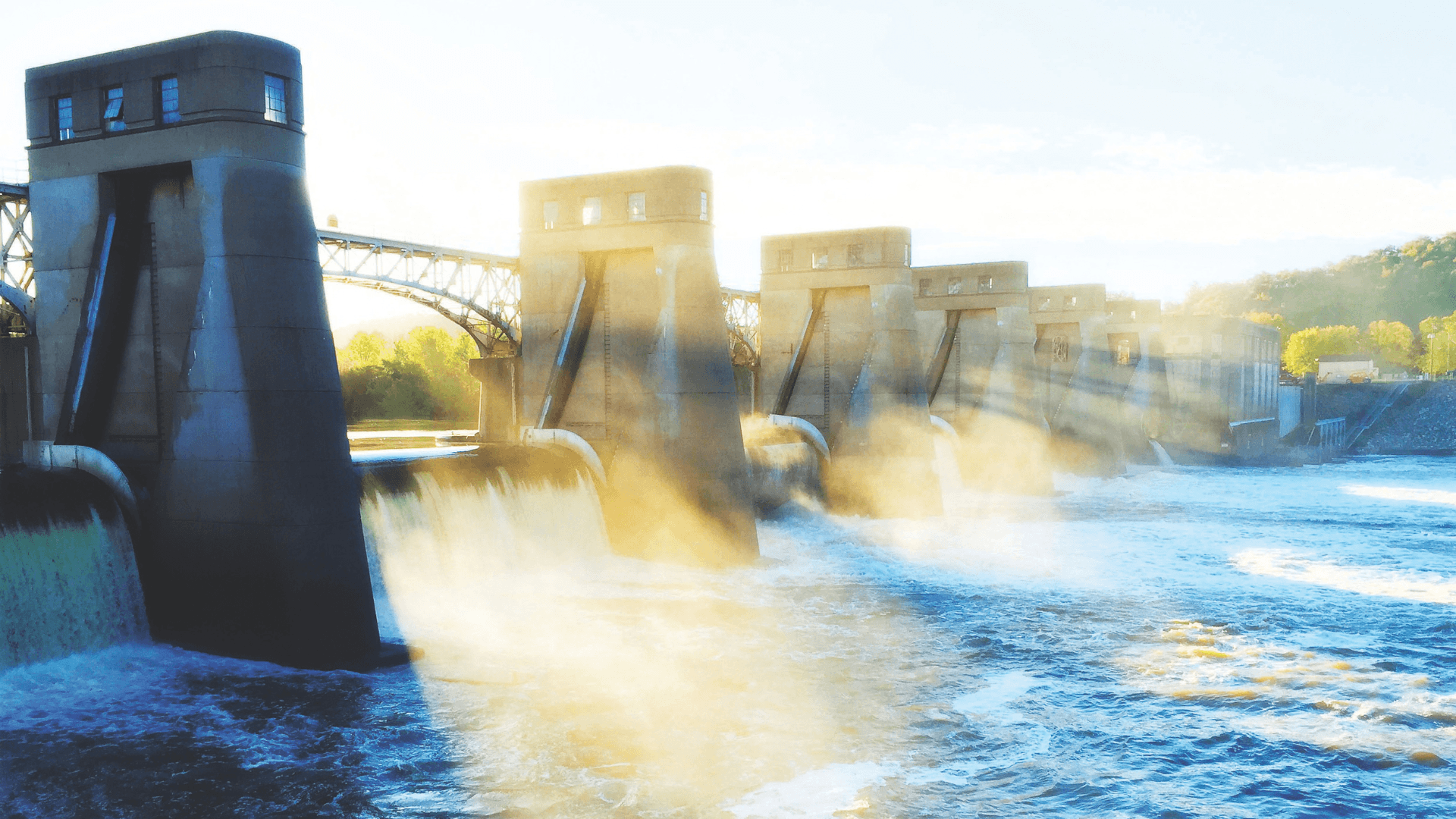
Winfield Locks and Dam is located at River Mile 31.1 on the Kanawha River in West Virginia, impounding a navigation pool that extends approximately 36.6 miles upstream to Marmet Locks and Dam. Growing concerns regarding the structural integrity and operational reliability of the facility’s six roller gates have prompted the U.S. Army Corps of Engineers Huntington District (LRH) to explore the implementation of an emergency closure system to mitigate the risk of full or partial gate failure, uncontrolled discharge, and subsequent pool loss.
Deployment of any such closure system is substantially constrained by existing infrastructure. The project lacks an overhead bridge crane, and the current bridge superstructure is rated strictly for pedestrian loads, requiring any emergency closure assembly to be deployed via a floating, barge-mounted crane operating on the upstream pool. While Winfield currently maintains a set of maintenance bulkheads that offer a useful baseline for physical dimensions and slot geometry, these units are designed exclusively for placement under static, equalized hydrostatic head and cannot safely arrest uncontrolled flowing water without rigorous hydrodynamic evaluation and structural redesign.
Project Objective
The objective of this prototype project is to conduct research and complete the engineering design for an emergency closure system at Winfield Locks and Dam capable of halting uncontrolled flow during a primary roller gate failure. The design must encompass the complete closure structure, specialized lifting beam, and associated rigging, ensuring safe downstream placement into active flow without exceeding the structural thresholds of existing site infrastructure or Load Handling Equipment (LHE).
Project Manager
Coastal and Hydraulics Laboratory (CHL), U.S. Army Engineer Research and Development Center (ERDC)
Requirements
ERDC is seeking prototype solutions that satisfy the following technical and operational requirements:
- Deployment & Placement: Must be deployable under active flow conditions from the downstream side of the dam.
- Hydrodynamic Loading & Analysis: Must account for hydrodynamic forces (downpull, uplift, and flow turbulence) acting on the closure system and quantify the resulting dynamic loads transmitted to the LHE.
- Lifting Beam & Rigging: Must include an engineered, dedicated lifting beam and all necessary rigging hardware to support underwater latching and stable transit.
- Governing Design Standard: All structural components, load cases, and load combinations must comply with USACE EM 1110-2-2107: Design of Hydraulic Steel Structures.
- Dimensional Envelope: Must fit within the geometry and confines of the existing dam bulkhead recess.
- Span: Must span approximately between pier monoliths.
- Design Head: Must accommodate a minimum design head of 27 ft.
Applicants must be registered on SAM.gov. Submissions should NOT include confidential or proprietary details.
Estimated Government Funding Profile
Funding of up to $2,100,000 may be awarded under this effort. The government anticipates fully funding the prototype project upon award.
The government intends to award one or more other transaction(s) from this project announcement. The selected vendor will be fully funded to execute the research and design starting in FY27 and concluding in FY28.
The USACE, ERDC is using competitive procedures to select participants in a prototype transaction under 33 U.S.C 2313. If the prototype proof of concept and design is determined successful, agencies may exercise authority under 33 U.S.C. 2313(c)(2) to provide for, and award, a follow-on production transaction or FAR based contract without additional competitive procedures to assemble the prototype model.
Estimated Period of Performance
The estimated period of performance for a prototype is 12 months after award.
Expected Result
This effort will produce a complete engineering design package for an emergency closure system capable of mitigating uncontrolled flow resulting from a roller gate failure at Winfield Locks and Dam. The resulting design will include structural analyses, hydrodynamic load evaluations, lifting and rigging requirements, and supporting documentation necessary to inform future system fabrication and deployment.
Evaluation Criteria
White papers will be reviewed based on an integrated assessment of the following:
- The degree to which the solution meets the requirements of the desired objectives.
- Offeror(s) stated capabilities to develop a proof of concept and design, provide project management, and assemble all aspects of the prototype model. Including, but not limited to, ability to conduct a site assessment.
- The degree to which the potential delivery schedule meets the government’s stated period of performance.The evaluation of potential impacts of data rights assertions.
- The review of whether the white paper sufficiently demonstrates 1) significant participation by Non-Traditional Defense Contractors (NDCs) or significant participation by non-profit research institutions, 2) all significant participants in the transaction other than the Federal Government are small businesses, or 3) at least one-third of the total cost of the prototype project is to be paid out of funds provided by parties other than the Federal Government.
Notional Project Schedule
Proposed project milestones include:
| October 6, 2026 | Project Announced, Submissions Open |
| October 16, 2026 | Question Period Ends |
| October 23, 2026 | Submissions Close |
| October/November 2026 | Evaluation Period, Virtual Pitch Hosted (if needed) |
| December 2026 | Selected Participants Notified by ERDC of Request for Full Proposal |
*If needed; dates may vary to accommodate project team and participant availability. The government may accelerate the pre-proposal review/feedback timeline, and therefore also require earlier delivery of full proposals.
Project Security Classification
Unclassified
How to Participate
1. Review the complete solicitation
2. Review FAQs
3. Once the white paper is ready to submit, complete the submission form
Questions: Please send all technical and administrative questions using this form. FAQs will be updated periodically. It is the responsibility of the offeror to review FAQs prior to submitting.
Submissions must meet stated requirements and be received no later than 5:00 pm CT on October 23, 2026.
Submissions should NOT include confidential or proprietary details. Submissions will be reviewed by ERDC/government subject matter experts and may be shared as appropriate with other ERDC parties. The government has the authority to decline all submitted proposals. The government does not plan to engage in the debrief process outlined in FAR part 15, but will provide feedback to unsuccessful offerors as appropriate and at its discretion.
ERDC seeks to enter into non-FAR or FAR-based agreements with Industry, Academia, and National Lab partners whose solutions are favorably evaluated. As such, this project is considered competitive in the same manner as a Broad Agency Announcement (BAA) or Commercial Solutions Opening (CSO), and solutions will be evaluated independently of one another primarily for technical merit.
Notice: The USACE, ERDC is using competitive procedures to select participants in a prototype transaction under 33 U.S.C 2313. If the prototype proof of concept and design is determined successful, agencies may exercise authority under 33 USC 2313(c)(2) to provide for, and award, a follow-on production transaction or FAR based contract without additional competitive procedures to assemble the prototype model.